
With the start of 2026 a number of new laws went into effect regarding e-bikes, speed limits, red light cameras, and public meeting access.
Read on for complete details, and share this info with your friends to help spread awareness!
New E-Bike Regulations
Senate Bill 586: Defining off-highway electric motorcycles
Read the complete bill summary here.
There are currently some devices which either don’t meet legal e-bike requirements, or which can be adjusted by the user to exceed legal limitations.
These devices are not allowed on any public streets or sidewalks. However, some are currently being purchased by individuals without an understanding of these restrictions.
This new law intends to provide a clearer distinction, defining “off-highway electric motorcycles” (also known as an “e-motos”) as vehicles that are designed primarily for use on dedicated off-road trails (like at ATV parks).
These devices must have a straddle seat, no pedals, and other requirements to distinguish them from e-bikes.
Devices that don’t meet any existing device definition are not permitted for use on any public facility.
Assembly Bill 875: E-device impoundment
Read the complete bill summary here.
This bill enables local police to impound any unauthorized or unlicensed e-device for at least two days.
This applies to devices that don’t meet any of California’s three official e-bike classifications, either through the manufacturer design or as a result of alteration by the user.
This impound authority also applies to any Class 3 ebike (28 mph limit) being used by someone under 16 years old, as these devices are only legal for use by riders 16 and up.
The local jurisdiction may impose a charge to the user to recover their device, as long as the fee does not exceed administrative costs related to the impound.
They may also require the device owner to complete an electric bicycle safety and training program as a condition of release.
Senate Bill 1271: E-bike battery safety and storage
Read the complete bill summary here.
This bill was passed in 2024, but some provisions about e-bike battery safety finally went into effect in 2026. This includes the following:
- Manufacturers/sellers/renters must ensure that e-bikes, batteries, and charging systems meet accredited lab safety standards (such as UL 2849 or EN 15194).
- Products must display the testing lab’s logo and standard.
- Sellers must provide test reports upon request.
This bill also requires the State Fire Marshal to adopt regulations that promote the fire and electrical safety of electric bicycles.
Assembly Bill 544: E-bike reflectors and youth helmet enforcement
Read the complete bill summary here.
Previously California state law required all bikes (including e-bikes) after dark to have either a red rear reflector visible from a distance of 500 feet when in a car’s headlights, or a flashing or solid red rear light with a built-in red reflector.
This new law also requires a red rear reflector on e-bikes at all hours, not only after dark. More info at BikeEastBay.org/NightRiding
The purpose of this law is unclear, as reflectors only work when car headlights are pointed at them, but the law does not require drivers to use their headlights during daylight.
This bill also enables any fee from a ticket written for a youth bicycle helmet violation to be waived, if a parent/guardian shows proof that the child has a helmet and has attended a bicycle safety class.
Note:
More California e-bike legislation has been proposed, some helpful and some not. To track ongoing developments please visit the California Bicycle Coalition’s website here.
Speed Limit Updates

Previous legislative sessions have passed laws allowing local jurisdictions to lower speed limits in many circumstances. Visit the UC Berkeley SafeTREC website here for a summary of these changes.
Two more updates were adopted for 2026. Click on each of the summaries below for details:
Assembly Bill 382: Speed limit reductions in school zones
Read the complete bill summary here.
This bill authorizes local jurisdictions to reduce existing 25 miles per hour speed limits in a school zone down to 20 miles per hour, by ordinance and without a traffic survey required.
The bill also authorizes speed limit reductions to 15 miles per hour within school zones, if the roadway has no more than two traffic lanes and a speed limit no higher than 30 miles per hour before and after the school zone.
Assembly Bill 1014: Speed limit reductions on state-owned roads
Read the complete bill summary here.
Historically speed limits have been set based on measurements of how fast drivers are going.
Because of this, when drivers speed more the posted limits would then be set even higher, creating a cycle of increasingly faster and more dangerous streets.
State law updates in recent years (read more here) changed this to allow jurisdictions to round down and reduce the limit to the next closest 5 mph increment, instead of rounding up. They may then reduce a speed limit an additional 5 mph for areas with many pedestrians, bicyclists, or other vulnerable road users, or on designated “safety corridors” that see high rates of crashes.
But this only applied to locally-owned roadways, and not Caltrans-owned state roads which are some of the most dangerous (like San Pablo Ave, International Blvd, Mission Blvd, Ashby Ave, etc).
This new bill now extends this allowance to also apply to state roads.
Red Light Cameras
Senate Bill 720: Red light camera enforcement
Read the complete bill summary here.
Red light camera systems have previously seen inconsistent results with regard to street safety.
In some cases where the cameras were installed, cities also reduced the yellow light timing in order to write more tickets, and collect more fees.
However, this also led to more rear-end crashes as drivers started braking harder to avoid getting caught by the short yellow phase.
This bill intends to improve on these outcomes by imposing new requirements for red light camera programs that orient their placement and design around street safety priorities, and eliminate their use for local revenue generation.
The details are oriented similarly to California’s speed camera pilot program which was authorized with the passage of Assembly Bill 645 in 2023 (info here).
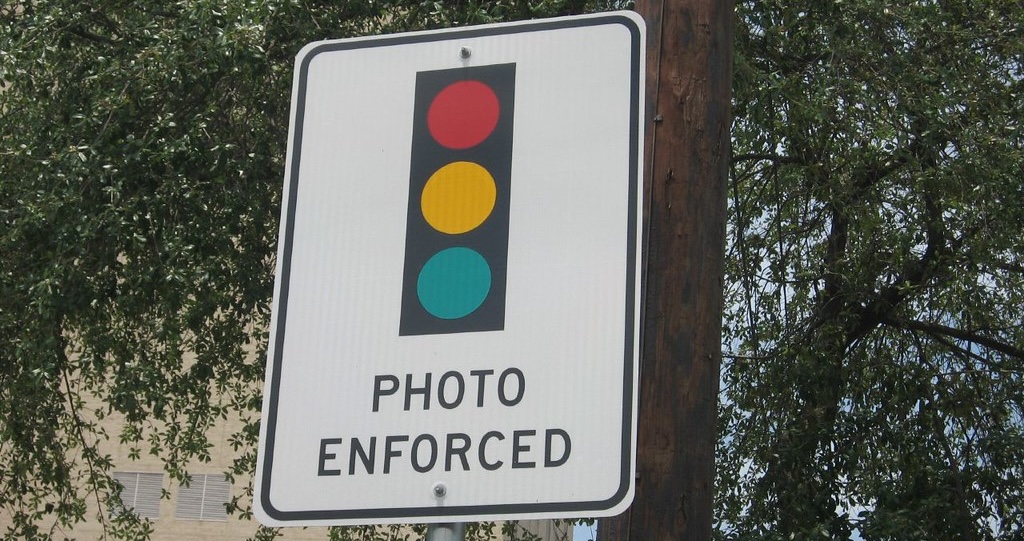
This red light camera bill also includes similar data security provisions as the speed camera pilot, requires similar warning signage around any camera locations, and a 60-day warning period after the cameras are installed.
Any ticket revenue above the cost for administering the program is required to be spent on local traffic calming. Otherwise the money goes instead to the state Active Transportation Program. This way these programs can not be used as money-makers to boost a local jurisdiction’s general fund.
The tickets are civil violations with monetary fees but no drivers license points. The cost for the first violation is $100, then $200 for a second within 3 years, $350 for a fourth, then $500 for a fifth or more.
These requirements apply for any new red light camera systems installed in California starting on January 1st, 2026.
Public meeting and teleconference requirements
Senate Bill 707: Open meetings and teleconference requirements
Read the complete bill summary here.
Starting on July 1st, 2026, all city councils and other legislative bodies in California will be required to provide both virtual as well as in-person viewing and public commenting options.
Meeting agendas, website materials, and live translations will also be required to be provided in locally applicable languages.
While many jurisdictions have already been offering these options, some East Bay cities (such as Antioch City Council) currently only offer in-person meeting viewing and public comments.
These requirements apply to city councils in cities with a population of 30k or more, county boards of supervisors in counties with a population of 30k or more, or any city council in a county with a population of 600k or more. As such this is relevant everywhere in Contra Costa and Alameda Counties.
This bill also enables but does not require appointed, non-legislative advisory committees or commissions (like bike/walk committees) to offer virtual as well as in-person meeting options.
The virtual meeting option must be approved by the legislative body which established the advisory committee/commission, and this option must be renewed every six months to remain active.
While not a requirement, we at Bike East Bay highly recommend that all East Bay jurisdictions offer hybrid in-person and virtual meeting participation options for all bike/walk committees and commissions, in order to promote the attraction, retention, and diversity of meeting participants.
Due to time constraints, childcare, travel, meals, and more, many people do not have the capacity to participate at public meetings in-person. Enabling hybrid meeting participation is one step to help increase representation and engagement in these spaces.

