
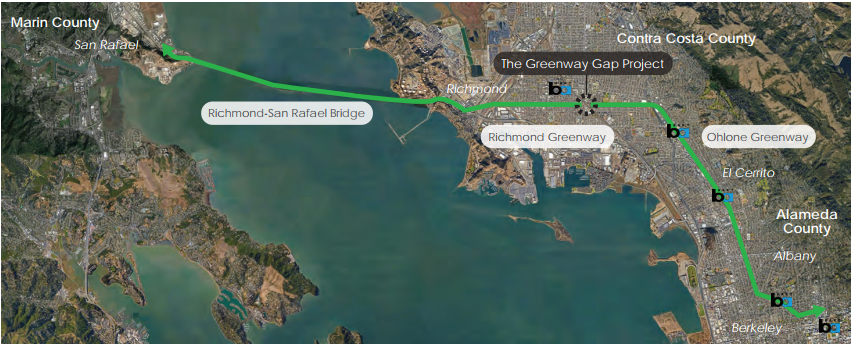
The Richmond Greenway is a 2.5 mile east-west bicyclist and pedestrian pathway that runs between San Pablo Ave and 2nd Street. It connects with the Ohlone Greenway in El Cerrito, continuing another 4.5 miles to the south to Berkeley.
To the west, the Richmond Greenway connects to a network of streets that lead to the Bay Trail, bringing people from the East Bay all the way to San Rafael in Marin County.
This combination of trails and streets link 5 cities and the 3 counties of Alameda, Contra Costa and Marin, making the Greenway a trail of immense local and regional significance.
However, there’s a major gap at 23rd Street in Richmond that discourages many locals and visitors from using the Greenway.
The gap sits between Dirt World on the 23rd Street side and Carlson Blvd in the Pullman neighborhood of Richmond.
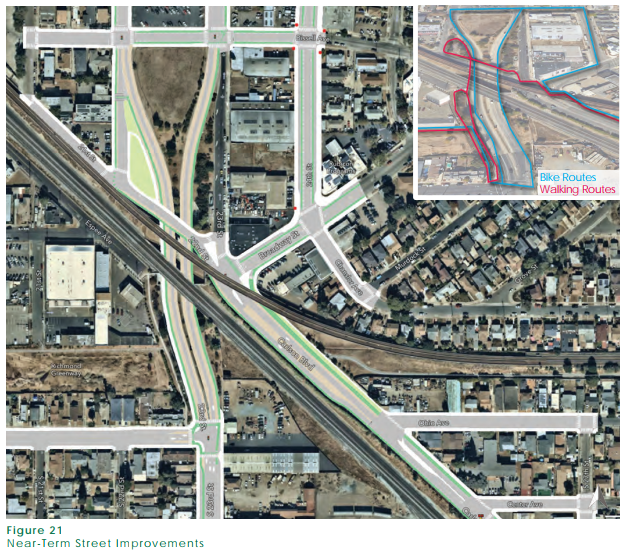
If you draw a straight line, the distance between one side of the Richmond Greenway and the other is only 500 feet. But one is forced to circumnavigate a confusing half a mile of twists and turns including an underpass with steep grades to reach the other side. The 0.5 mile long detour through city streets takes ~5 minutes for people to traverse on a bike. It is a little shorter distance for pedestrians at 0.4 miles, which takes ~9 minutes.
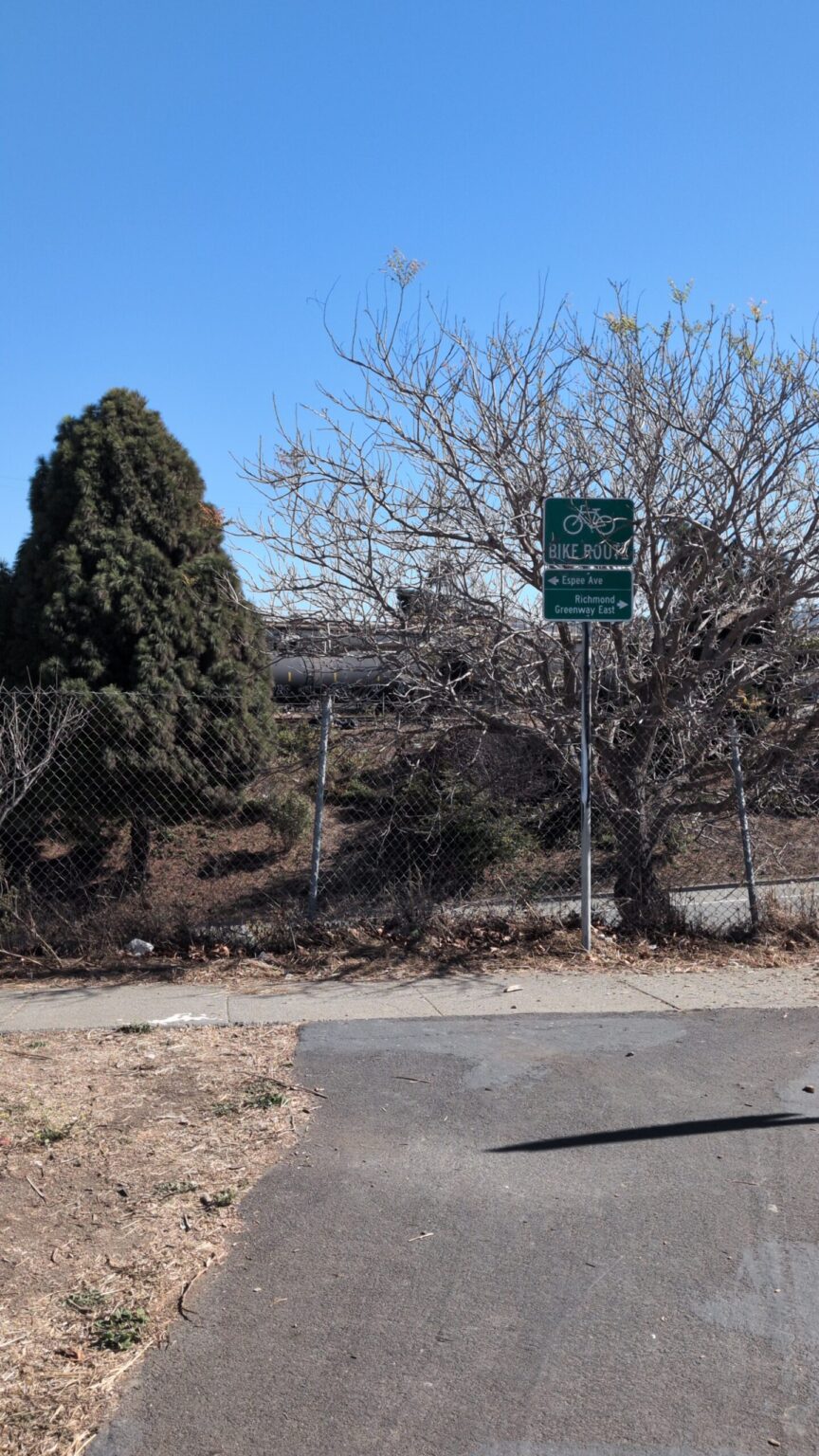
Over the years, I’ve seen kids walking to school get lost in the maze of confusing turns. On separate occasions I have seen adults take dangerous shortcuts or carefully ride against traffic merely out of frustration as they couldn’t figure out a way to cross to the other end. While there are some signs to help guide you, it’s counterintuitive so it’s still a challenge if you’re not familiar with the route.
There is a solution in the works: a bridge
With vast community participation and a technical advisory committee that included support from Bike East Bay, the City of Richmond completed a Richmond Greenway Gap Closure study in 2023. The study developed concepts for a future bridge as well as street and park improvements. The final bridge design is inspired by an osprey.
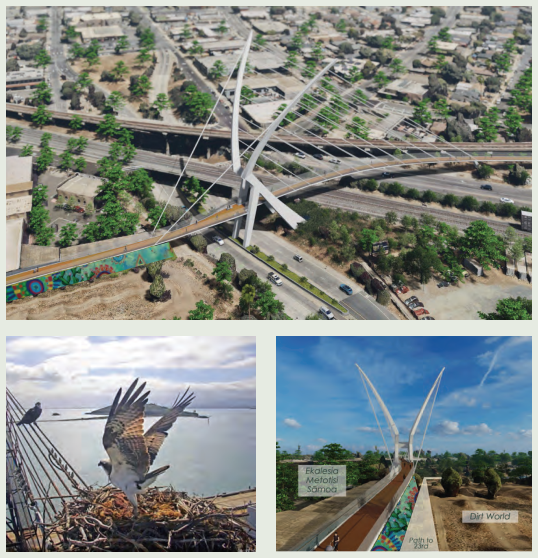
The Richmond Greenway Gap Closure study recommends park improvements with amenities like seating, drinking fountains, and lighting that would increase comfort, accessibility, and contribute to better personal security, a known issue in the area. Greenway improvements would provide important benefits to lower income, communities of color who live in the neighborhoods next to the Greenway, including improved walking and biking access to local and regional destinations.
These are the transportation recommendations for the short and the long term.
Near term
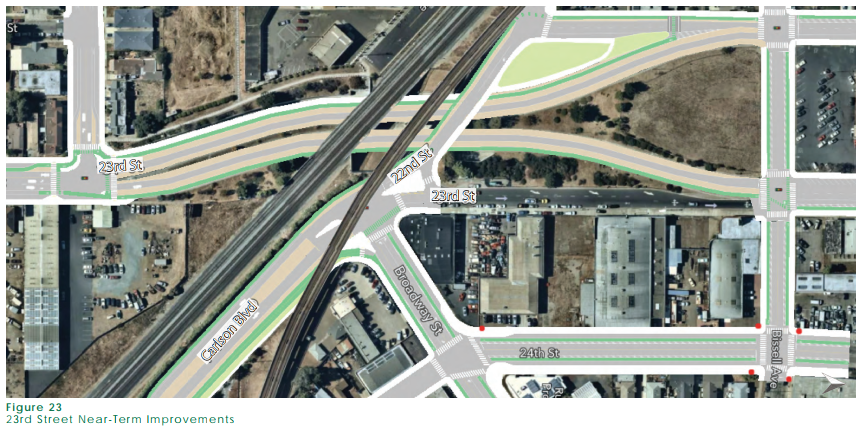
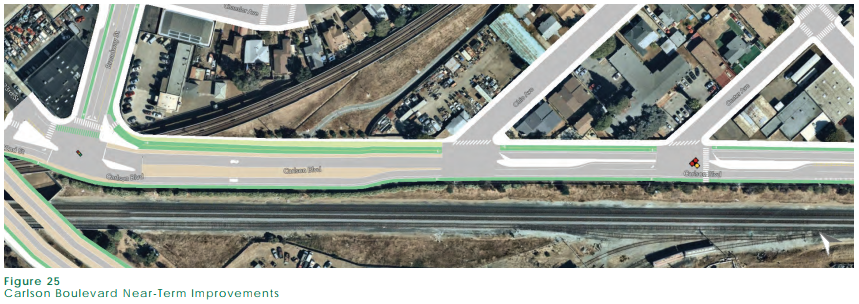
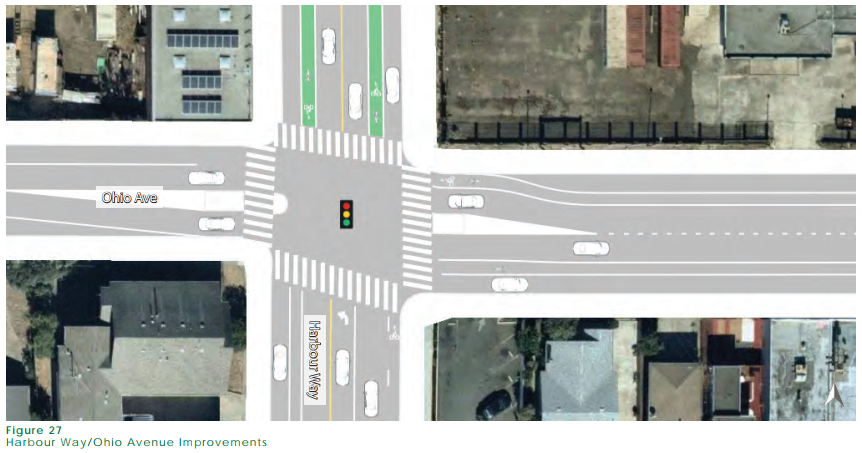
Enhancements to improve safety and alleviate the challenges people face crossing the gap today:
- Quick build protected bike lanes on 23rd Street, Carlson Boulevard, and Bissell Avenue
- Protected intersection at Ohio Avenue/23rd Street
- Repurposing vehicular travel lanes on 23rd Street and Carlson Boulevard and parking removal on Bissell Avenue
Long-term Improvements would include:
- A two-way separated bike lane on 23rd Street
- Widening the sidewalk and installing a two-way bicycle path on Carlson Boulevard
- Streetscape enhancements including landscaped bike lane buffers, additional street trees, and landscaping at residential cul-desacs
Bridge construction is currently estimated to cost between $30 and $40 million dollars
It’s likely going to take some time until it’s built, but the good news is that in July 2026, the City of Richmond was awarded a $700,000 Caltrans grant that will help move the project forward. These funds enable the city to complete the implementation plan and 30% design concepts, which went out to bid on October 19, 2026 with a deadline for submittal of November 2026.
Per the request of proposals:
The City of Richmond seeks to advance the Richmond Greenway Bridge Project from concept planning to an Implementation Plan and up to 30 percent conceptual design.
The project will develop a grade-separated, ADA-accessible bicycle and pedestrian bridge over the Union Pacific Railroad right-of-way, 23rd Street, and Carlson Boulevard, closing a critical gap in the Richmond Greenway and strengthening regional active transportation connectivity. By reconnecting the east and west segments of the Greenway, the project will improve safety, expand equitable access to trails and transit, support climate and mode-shift goals, and enhance mobility for people walking, bicycling, rolling and using mobility devices.
Bike East Bay is a Project Stakeholder. Stay tuned for community outreach opportunities as the project moves along: sign up for our Bridging the Bay campaign email list to get notifications.
Historically, Bike East Bay’s Bridging The Bay campaign helped build active transportation trails on many bridges, including the Carquinez Bridge cited on this 2004 SF Gate article extract:
Julian Carroll, Caltrans’ bicycle coordinator for the Bay Area, credited activists, particularly the East Bay Bicycle Coalition, with getting the state to put a pedestrian and bicycle lane into the bridge’s design.
“It proves that activism in the Bay Area is strong,” said Carroll, who predicted the span will become an attraction to bicyclists who now train in the Napa and Sonoma valleys. Click on the link to read the full article: https://www.sfgate.com/bayarea/article/EAST-BAY-Carquinez-bridge-lane-opens-for-2777812.php